제목
LLVM: A Compilation Framework for Lifelong Program Analysis & Transformation
저자
Chris Lattner Vikram Adve
개인적으로 느끼는 논문의 insight
Lifelong Program Analysis개념을 도입하여 Front-end를 제외한 부분에서 전체적인 최적화를 수행,SSA,machine-independent optimization 논문에서 제시된 개념이 지금의 llvm과 정확하게 일치하지는 않지만 대단하다..
Motivation
- Multiple-stages of analysis & transformation
- compile-time, link-time, install-time, run-time, idle-time
- Use aggressive interprocedural optimizations
- Gather and exploit end-user profile information
- Tune the application to the user’s hardware
Contributions
- A persistent, rich code representation
- Enables analysis & optimization throughout lifetime
- Offline native code generation
- Must be able to generate high-quality code statically
- Profiling & optimization in the field
- Adapt to the end-user’s usage patterns
- Language independence
- No runtime, object model, or exception semantics
- Uniform whole-program optimization
- Allow optimization across languages and runtime
Instruction Set
- Avoids machine specific constraints
- Infinite set of typed virtual registers
- In SSA form
- Includes support for phi functions
- This allows flow insensitive algorithm to gain benefits of flow sensitive without expensive Data Flow analysis
- Avoids same code for multiple instructions (overloaded opcodes)
- Exceptions mechanism based on two instructions invoke and unwind
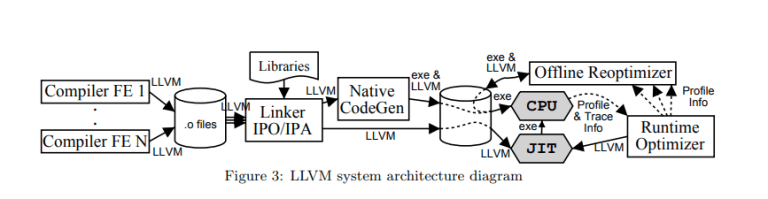
LLVM Compiler Architecture
- Some limitations
- Language specific optimizations must be performed on frontend
- Benefit to languages like Java(JVM) requiring sophisticated runtime systems?
- Front-end compiler
- Translate source code to LLVM representation
- Perform language specific optimizations
- Need not perform SSA construction at this time
- Invoke LLVM passes for global inter procedural optimization at module level
- Linker/Interprocedure Optimizer
- Various analyses occur
- Points-to analysis
- Mod/Ref analysis
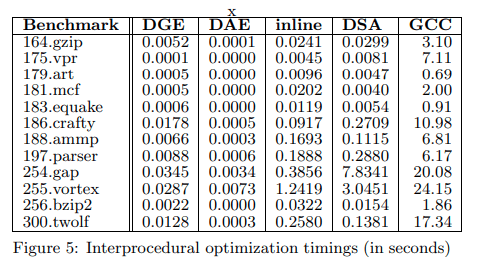
- Dead global elimination, dead argument elimination, constant, propagation, array bounds check, etc
- Can be speeded up by adding inter-procedural summaries
- Various analyses occur
- Native Code Generation
- JIT or Offline
- Currently supports Sparc V9 and x86 architectures
- Reoptimizers
- Identifies frequently run code and ‘hotspots’
- Performs additional optimizations, thus native code generation can be performed ahead of time
- Idle-time reoptimizer
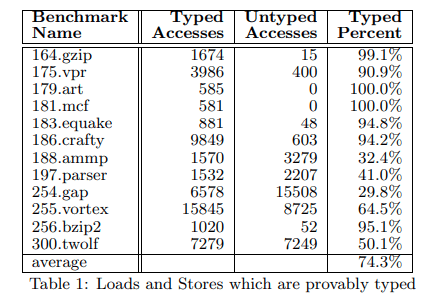
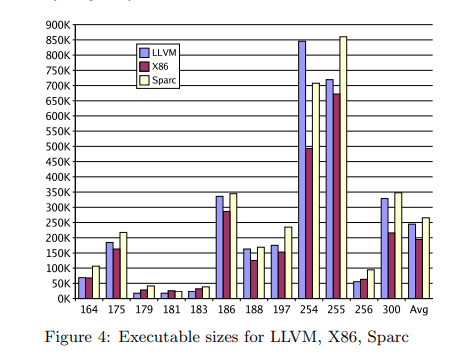
Results:How do high-level features map onto LLVM?
댓글