TAO: Tool-Aware Joint Scheduling for LLM-Based Agentic Serving
TAO: Tool-Aware Joint Scheduling for LLM-Based Agentic Serving Original: Shuhuai Li et al., "TAO: Tool-Aware Joint Scheduling for LLM-Based Agentic Serving"…
TAO: Tool-Aware Joint Scheduling for LLM-Based Agentic Serving Original: Shuhuai Li et al., "TAO: Tool-Aware Joint Scheduling for LLM-Based Agentic Serving"…
Diffusion language models must decide 'what' and 'where' at the same time Diffusion language models generate sentences by repeatedly filling masked tokens. To decode…
Introduction In settings where the batch size is close to 1, such as conversational services, the latency of a mixture-of-experts language model comes mostly from reading…
Recent language models keep increasing the amount of information packed into a single vocabulary entry. Per-layer embeddings (PLE), first introduced in Gemma 3n, carried…
The sequential bottleneck of sampling one token at a time Large language models can compute an entire sentence in parallel during training, but when generating text they…
The Cost and Accuracy Dilemma of Long Agent Trajectories LLM agents accumulate long trajectories by repeating reasoning and tool calls for hundreds of rounds. To make…
DLite explained through a candidate-verification example, cache ownership, and a careful comparison of acceptance length and decoding speed.
An analysis of SpecAgent, where a weaker model drafts tool calls and a stronger model verifies them, covering its design, experimental results, and limitations.
DCOCO reselects existing parallel draft candidates using contextual scores. This review distinguishes accepted length from actual throughput and examines correction…
SparseDecoding calibrates pruning on model-generated tokens and adds a decoding-specific sparse kernel. We examine the conditions behind its maximum 1.48× speedup on A100…
TokenRouter: An Efficient Serving System for Token-Level LLM Routing TL;DR — Routing an LLM at the token level rather than the session/query level can substantially push…
How to Hand Off KV Caches As-Is Between Different LLMs: HeteroFold TL;DR: HeteroFold, a method that reuses the KV cache between models with different tokenizers and…
WavePP — A Pipeline-Parallel Prefill Runtime That Burns In Prefix Reuse TL;DR Built on top of TensorRT-LLM, WavePP overlaps request admission (reuse consensus, cache…
Who pays for the KV cache? — Kubernetes, gateway, and provider bills in one ledger TL;DR — The cost of a single AI feature is scattered across three disconnected ledgers:…
SPECTRA: A Reconfigurable LLM Accelerator That Changes Its Hardware With Every Inference Stage TL;DR Speculative decoding oscillates between prefill (compute-bound GEMM),…
Branching on Compressed Memory: Adding Tree Reasoning to DeepSeek-V4 TL;DR Adding tree-structured speculative decoding to DeepSeek-V4-Flash yields longer acceptance…
Flash-dLLM: I/O-First Diffusion LLM Acceleration, Unlocking 210.6 tokens/s with Fused Cache and Self-Verification One-Line Summary (TL;DR) Diffusion LLMs (dLLMs) support…
Analytical PD-inference provisioning uses instance counts and KV-cache reservations to find the lowest-power deployment for a target capacity.
Fathom: Accelerating 1M-Token Decoding by 1.67x with Query-Adaptive Depth Scanning TL;DR When agent sessions stretch to 1M tokens and dozens of sessions reside…
Waking the MoE on SSD: Serving a 35B MoE at 20 tok/s on a 24 GB Desktop with Edge0 One-line summary (TL;DR) Even at 4-bit, a 35B-class MoE occupies 19.5 GB and cannot…
Is "Lossless" Speculative Decoding Really Lossless? — The Numerical-Precision Trap Exposed by Reproducing Orthrus TL;DR — Orthrus attaches a diffusion view to a frozen AR…
CoVeR: Coverage-Based Pruning That Cuts Visual Tokens of Multi-View 3D Reasoning by up to 92% Using Geometry Alone One-Line Summary (TL;DR) Rendering a 3D scene into…
Deadline-Filling Prefill Chunks: SLOWeave — An Adaptive Chunking Scheduler for LLM Serving TL;DR — Instead of a fixed prefill chunk size, we propose SLOWeave, an online…
"Let's put an OS on the GPU": A proposal for a GPU multitasking OS layer for the LLM era One-line summary (TL;DR) In LLM serving, GPUs often stay at ≤10% utilization…
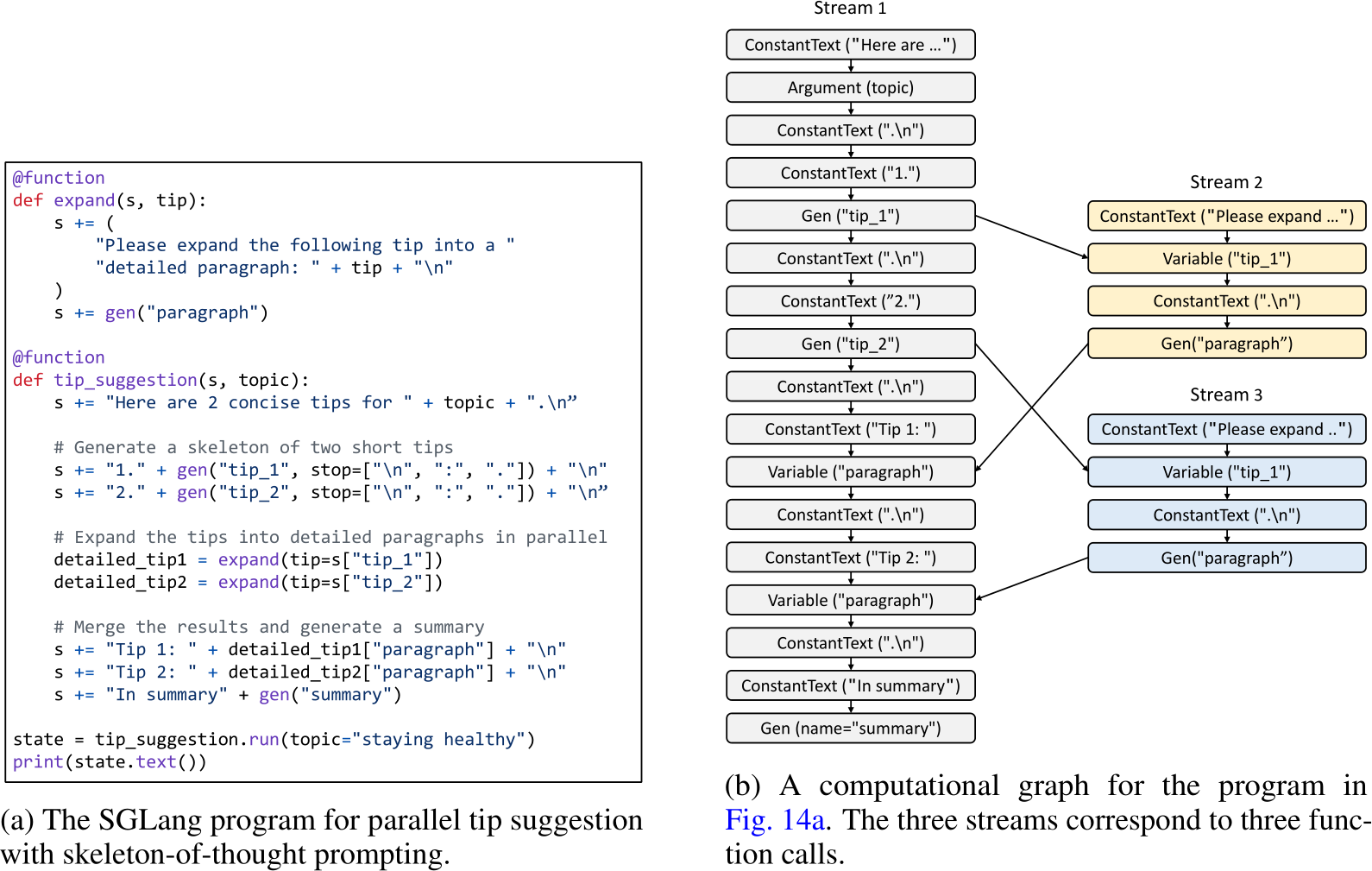
SGLang & RadixAttention: How Execution Optimization for "LM Programs" Achieved a 6.4x Speedup TL;DR By combining a language-runtime co-design with RadixAttention (radix…