TAO: Tool-Aware Joint Scheduling for LLM-Based Agentic Serving
TAO: Tool-Aware Joint Scheduling for LLM-Based Agentic Serving Original: Shuhuai Li et al., "TAO: Tool-Aware Joint Scheduling for LLM-Based Agentic Serving"…
The problem is always the same — the KV cache grows with the decode length — but the ways out differ. The axes these posts split along:
TAO: Tool-Aware Joint Scheduling for LLM-Based Agentic Serving Original: Shuhuai Li et al., "TAO: Tool-Aware Joint Scheduling for LLM-Based Agentic Serving"…
Diffusion language models must decide 'what' and 'where' at the same time Diffusion language models generate sentences by repeatedly filling masked tokens. To decode…
Recent language models keep increasing the amount of information packed into a single vocabulary entry. Per-layer embeddings (PLE), first introduced in Gemma 3n, carried…
Problem: Why It's Hard to Unify Understanding and Generation in One Representation There have been many attempts to merge image understanding and image generation into a…
The Cost and Accuracy Dilemma of Long Agent Trajectories LLM agents accumulate long trajectories by repeating reasoning and tool calls for hundreds of rounds. To make…
DLite explained through a candidate-verification example, cache ownership, and a careful comparison of acceptance length and decoding speed.
HLA-WM retrieves past chunks using camera geometry to restore scene memory. At 60 seconds, its history memory is about 12× smaller than Full KV and 6× larger than GDN,…
Fixed-point behavior connects KV sharing, state reuse, and distilled prefill in looped language models. We review the savings and accuracy trade-offs demonstrated on…
TRACE: Rollout-Aligned FP4 Quantization-Aware Training — MoE LLM RL at BF16 Quality, up to 5.4x Faster TL;DR In reinforcement learning (RL) for MoE LLMs, quantizing…
SlimKV: Compressing Tokens and Features Together, Cutting the KV Cache by up to 32× with Reconstruction-Free Latent-Space Attention TL;DR SlimKV is a question-agnostic…
TaSQ: 'Tailored Design' of the Quantization Space for a 1-bit KV Cache TL;DR — TaSQ (Tailored Space Vector Quantization) redesigns the very target space to which vector…
How to Hand Off KV Caches As-Is Between Different LLMs: HeteroFold TL;DR: HeteroFold, a method that reuses the KV cache between models with different tokenizers and…
The KV Cache Is the New Memory Wall: Three Regimes and Five Domains of Long-Context LLM Inference TL;DR — Long-context LLM decode inference is bound by memory bandwidth,…
WavePP — A Pipeline-Parallel Prefill Runtime That Burns In Prefix Reuse TL;DR Built on top of TensorRT-LLM, WavePP overlaps request admission (reuse consensus, cache…
Phase Sensitivity: The 'Periodic Weakness' Created by Chunked KV-Cache Compression TL;DR — In models that use chunked KV-cache compression (such as the DeepSeek-V4…
WorldAttention: System Co-Design of an Interactive Video World Model That Drops the Sliding Window TL;DR — Text-controlled interactive video world models are trapped…
PISA: Pyramid Top-$K$ Selection Lowers the Cost of Block-Sparse Attention to $O(N\log N)$ TL;DR — Block-sparse attention makes attention computation linear, but block…
Who pays for the KV cache? — Kubernetes, gateway, and provider bills in one ledger TL;DR — The cost of a single AI feature is scattered across three disconnected ledgers:…
LumoTree: Path-Parallel Speculative Verification for Hybrid Language Models TL;DR — Tree speculative decoding in hybrid models that mix Gated DeltaNet with full attention…
Branching on Compressed Memory: Adding Tree Reasoning to DeepSeek-V4 TL;DR Adding tree-structured speculative decoding to DeepSeek-V4-Flash yields longer acceptance…
Flash-dLLM: I/O-First Diffusion LLM Acceleration, Unlocking 210.6 tokens/s with Fused Cache and Self-Verification One-Line Summary (TL;DR) Diffusion LLMs (dLLMs) support…
Parallel Inference without Drafter-Side KV Cache: H-Spec's Hybrid Speculative Decoding TL;DR shows that the bottleneck in concurrent serving is that a block-diffusion…
Analytical PD-inference provisioning uses instance counts and KV-cache reservations to find the lowest-power deployment for a target capacity.
DeepSeek-V4.1-Flash: A Multimodal MoE That Cuts the KV Cache to 1/4 While Raising Performance Further TL;DR. DeepSeek-V4.1-Flash, released by DeepSeek-AI, is a multimodal…
Fathom: Accelerating 1M-Token Decoding by 1.67x with Query-Adaptive Depth Scanning TL;DR When agent sessions stretch to 1M tokens and dozens of sessions reside…
ZGCM-1: How a 7B Dense Model Trades Blows with 235B Frontiers — A Fully Open, Ultra-Efficient Foundation Model Design Report TL;DR — With a single 7.39B dense model,…
SAS: A Simple Attention Sparsification That Learns Context Ranking Directly Without Distillation TL;DR — In post-training attention sparsification, inject the continuous…
CoVeR: Coverage-Based Pruning That Cuts Visual Tokens of Multi-View 3D Reasoning by up to 92% Using Geometry Alone One-Line Summary (TL;DR) Rendering a 3D scene into…
Linear Attention Rewritten with a Kalman Filter: Kalman Delta Networks TL;DR The fixed-size recurrent memory update of linear attention is reinterpreted as a…
Deadline-Filling Prefill Chunks: SLOWeave — An Adaptive Chunking Scheduler for LLM Serving TL;DR — Instead of a fixed prefill chunk size, we propose SLOWeave, an online…
Why Are Video LLMs Still So Expensive? — A Four-Stage Guide to Inference Efficiency Mechanisms TL;DR — This paper classifies 125 VideoLLM inference efficiency studies…
VestigeKV: The Degenerate RoPE Branch Carries Its Own Cache Eviction Signal TL;DR In NoPE-MLA models (Kimi Linear 48B), reading only 11% of each row — the 64-dim…
ShallowStream: Index Shallowly, Answer Deeply — Unlocking the Computational Bottleneck of Streaming Video Understanding TL;DR — In streaming video understanding, the most…
Catch the Moment a Model "Revisits Its Thoughts": How BeaconKV Compresses Reasoning KV Caches 5.8× with Beacon Queries TL;DR — The KV cache of a Large Reasoning Model…
Language Models Control Their Own Attention: Declarative Attention TL;DR — Existing sparse attention methods still paid $O(N)$ per decoding step by approximating…
SGD-KV: Finding 'heads that are good at summarizing' cuts the 1M-token KV cache by up to 75% TL;DR — Attention heads do not all do the same job. SGD-KV pinpoints the…
SMELT: Scaling Laws for Compute-Matched MoE Loop Transformers TL;DR Loop transformers scale depth by executing a layer block repeatedly, but most prior work fixed only…
The Recurrent Half Is the Easy-to-Quantize Half: Why Gated DeltaNet Survives at 4 Bits TL;DR — The 48 recurrent Gated DeltaNet (GDN) layers of a hybrid 27B LLM…
The Scores Were a Waste: The Paradox Where 'Random Sampling' Ties the Strongest in KV Cache Eviction — An In-Depth Review of Random Attention TL;DR — Research on…
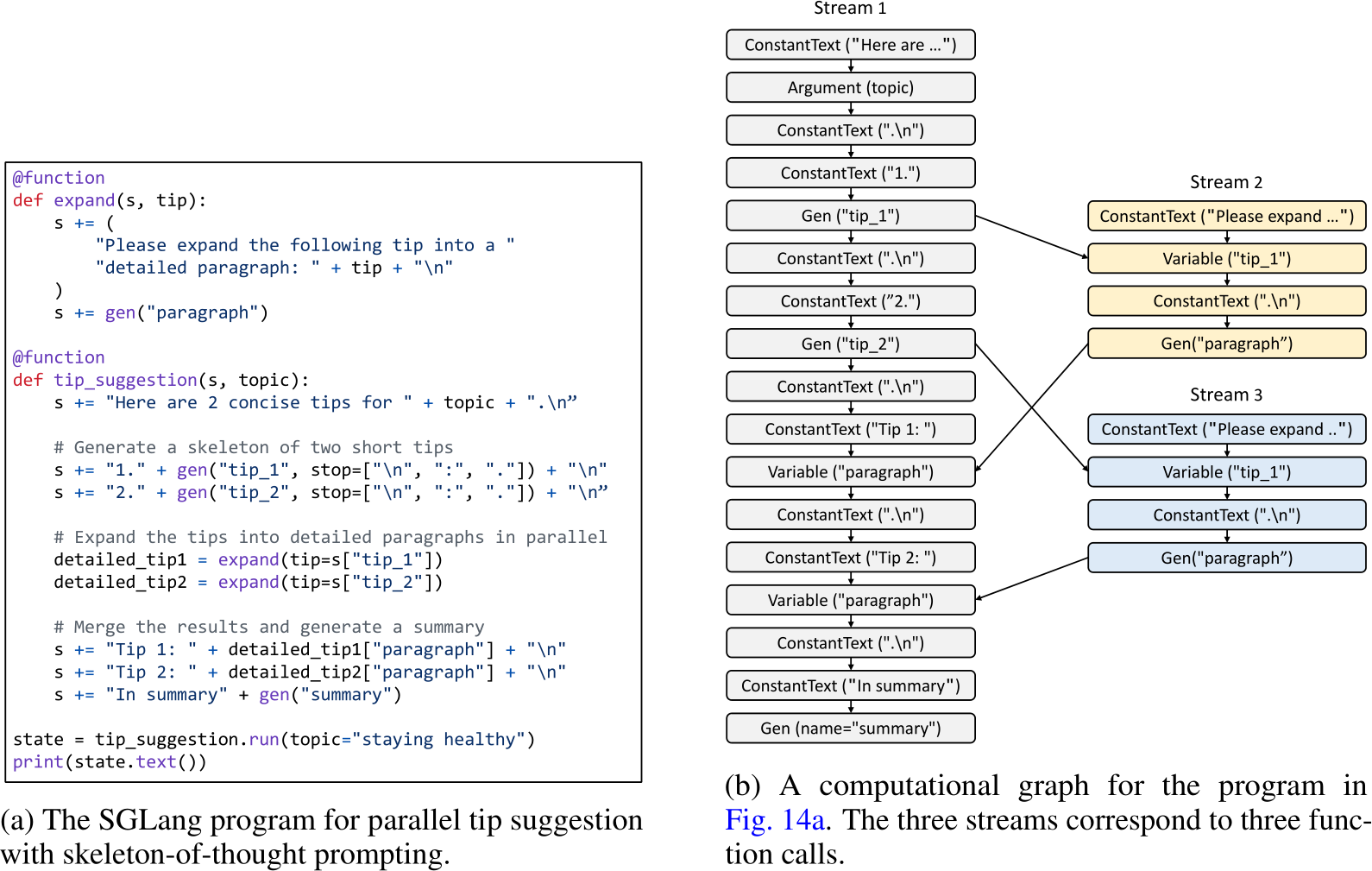
SGLang & RadixAttention: How Execution Optimization for "LM Programs" Achieved a 6.4x Speedup TL;DR By combining a language-runtime co-design with RadixAttention (radix…

Dynamic Memory Sparsification (DMS): Making LLM Hyper-Scaling a Reality with 8× KV Cache Compression One-Line Summary (TL;DR) DMS, combining a lightweight re-fitting of…